


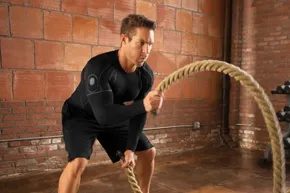
Let’s be honest: fitness mirrors are weird. Upbeat pop music plays while you sweat and squirm, making it feel like a narcissist’s playground. Most people don’t like it. Also, they are terrible tools for validating forms. You have to twist your neck at an awkward angle to see the legs move. A stretching routine that works for one person may mean a trip to the emergency room for another. In a world where we monitor everything else, monitoring our own body movements in real time without glass walls seems like the obvious next step.
We already have the wearable revolution. Devices like FitBit, Jawbone UP and Nike FuelBand are everywhere. They use accelerometers and gyroscopes to estimate steps taken and calories burned. These gadgets are perfect for counting your daily activities. However, little is known about what actually happens in the muscles.
Enter the Athos fitness clothing line.
This has nothing to do with counting steps. It’s a matter of accuracy. Athos’ clothes have sensors embedded directly in the fabric that monitor electrical activity in 22 different muscle groups. This is a more accurate way of measuring effort. This system is intended for both casual fitness enthusiasts and competitive athletes looking for some sort of benefit. In addition, it will help you find the right form. Maintaining proper form can help you avoid injuries that can keep you out of action for weeks. It also helps patients monitor the stress of the healing muscles and has potential applications in physical rehabilitation.
The device connects to your smartphone. The Athos app displays real-time data as you run, jump and stretch. See exactly which muscles are active and which are at rest. If the form is incorrect, you can correct it. If you use too much force, it may fall back. We turn vague initiatives into concrete information.
But how do you know if a T-shirt is really working your core? Is it worth the price of admission?
The Tech Behind the Fabric
Traditional trackers rely on movement. They know you moved. They don’t know “why” you’re moving or how hard your muscles are working to achieve that goal. Muscle activity produces electrical signals. These signals travel through the body before visible movement. Athos receives these signals directly by placing electrodes on your skin.
This provides an unprecedented level of detail for a wrist-worn device. You can see if your glutes are really activated during the squat or if your lower back is overloaded. This kind of feedback is very important for anyone trying to optimize their daily work.
“Athos clothing helps you measure your effort and find the right form. It helps you avoid injuries that can set your training back weeks or months.”
The data is entered into the application and provides immediate feedback. This is not just a record from yesterday’s event. It monitors your physiological functions in real time. Adjust your technique in real time. This is especially useful for complex movements that are difficult to correct on your own without a coach.
Who is this for? For those who consider fitness a science project. Suitable for athletes who want to avoid overloading one muscle group and neglecting another. People recovering from injuries should avoid putting too much stress on their recovering limbs.
The effect is more than just “burning calories”. It’s all about efficiency. It’s about doing important work and rising above the noise. It’s about having some confidence that your body will respond to your efforts in the way you want.
However, sensors in clothes cause new problems. Heat. Sweat. Washing machines. While the technology is impressive, the practicality of everyday use of e-textiles is completely different. Does it chafe? Does it wash well? Can it really be worn under a coat?
Hardware is only half the story. Whether this helps depends on the software and user experience
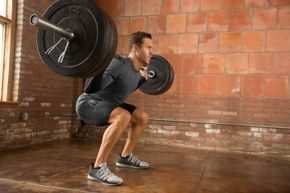

A real fitness trainer costs a lot of money. They know everything about human physiology. They understand the psychology of pushing boundaries. A good coach does more than just create a routine. They break down psychological barriers. Luxury pricing was the catalyst for Christopher Wiebe and Dhananja Jayalath.
Electrical engineering students from the University of Waterloo in Ontario, Canada spotted a gap in the market. They want quality feedback, but don’t want to spend six figures on a private tutor. So they used their free time to build a digital alternative. Their goal was simple but ambitious: to create a device that provides more actionable data than traditional fitness trackers.
The challenge is not the coding. This is biology. How can we turn the body’s invisible electrical clutter into actionable digital insights?
The Skinny on Sensors
They chose electromyography (EMG). Especially the surface EMG sensors. These small pads are applied directly to the skin. They don’t guess. These measure the actual electrical impulses that travel through the underlying muscle fibers.
Electromyography is not new. Doctors and researchers have used this tool for years to study neuromuscular diseases. They need to know exactly what happens when the muscles contract correctly. Or fails to. But applying this medical technology to consumer clothing is a different story.
Here’s how it works: Muscles are bundles of fibers. When your brain tries to lift something heavy, it sends electrical signals to your nerves. This signal hits the muscle fibers. They contract. This contraction produces a unique electrical signal. This is completely different from the static baseline of a resting muscle.
Athos sensors catch this specific signature. It doesn’t just tell you if your muscles are active or not. They measure the intensity of this activity. For smart wear, this accuracy is the difference between basic step counting and actual performance analysis.
“Quality personal trainers can also be expensive. That’s what motivates electrical engineering students Christopher Wiebe and Dhananja Jayalath…”
Metrics That Matter
Most fitness trackers track heart rate. Some track steps. Athos monitors muscular output. This difference changes everything.
When you use this system, you get real-time feedback on which muscles are working. You see which ones are under-recruited. You can identify imbalances before they become injuries. This system records the electrical activity of the muscles during exercise. This information helps users improve their forms. It can reveal whether you are using the wrong muscle groups to compensate.
For the average user, this means a personal coaching experience. You can see exactly how your body reacts to different loads. You understand the relationship between nerve drive and muscle contraction. It’s not just about burning calories. It’s all about optimizing the movement efficiency.
This technique bridges the gap between subjective feelings and objective knowledge. Your legs may “feel” like they are working hard. EMG sensors prove this. Or you may notice that your lower back takes more of the load than your glutes.
This level of insight has previously been limited to elite athletes with access to lab-grade equipment. Now it’s becoming wearable. The obstacles to serious fitness optimization have been lowered significantly.
Students turn academic projects into tangible products. They just don’t follow the movement. They want to track their efforts. electrical effort. The result is a system that speaks the language of the muscles themselves
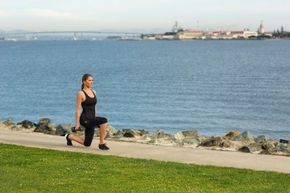
Accelerometers are everywhere. They are included in cell phones, car navigation systems and even missile guidance systems. They are the standard for tracking motion in fitness gear. But Athos doesn’t rely solely on them.
The company uses a 6-axis accelerometer as a baseline. This is very common. What sets Athos wearable devices apart from others is how they handle muscle activity. Most competitors simply count their steps or measure their swing speed. Athos goes deeper. It looks at what happens inside the muscle.
EMG sensor and muscle strength monitoring
The real difference here is the EMG sensor. These tiny chips detect the electrical signals generated when muscles contract. The system, used in conjunction with the Athos software, tracks three key metrics: muscle effort, toning, and fatigue. This information helps you understand how your body really responds to exercise, not just how many times you move.
Before you can track fatigue, you need a baseline. The system calculates the Maximum Voluntary Contraction (MVC). This is done during calibration. You can perform some basic exercises while the sensor reads its results. The core unit uses this information to determine safe exercise limits for individual home exercises. Exceeding this point is flagged. It’s a safety net for when no spotter is around.
Equipment: shirt and shorts
From April 2015, the Athos collection includes compression shirts and matching shorts. The fabric is very tight. It is elastic. It wicks sweat while it collects data. Designed to fit both male and female body types, without needing separate fits.
The sensors are not randomly placed. They have specific jobs. The shorts monitor electrical activity in the hamstrings, medial and lateral quadriceps, and bilateral glutes. They also include four heart-rate sensors.
The shirt is more complex. It has 14 EMG detectors, 4 heart rate monitors and 2 breathing sensors. There are a total of 24 sensors, all of which are woven into the fabric.
实时读取数据
当智能手机应用程序收到大量数据时,它不仅仅显示一个数字。 它显示目标肌肉群的图形表示。 该图显示了您的总努力百分比。 它还将精力分散到中间。 这可以揭示您的右侧是否过度补偿左侧。
颜色编码一目了然地告诉您强度级别。 绿色意味着你可能太轻松了。 白色表明你用力过猛。 目标是让屏幕保持在中间位置。
这种设计允许快速调整。 您可以在锻炼过程中查看手机。 看看不平衡的情况。 转移你的体重。 调回强度。 这是大多数健身追踪器不提供的即时反馈循环。
Platform compatibility
As of spring 2015, Athos is only available for Apple’s iOS. If you’re an Android user, you are out of luck for now. The company plans to release an Android version later. Until then, iPhone users will get the full experience.
This technique works. The information is fine-grained. Whether it changes how you train remains to be seen. But for those interested in the mechanics of their own movement, it offers a view most people never get to see.
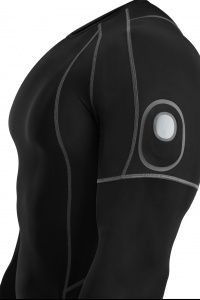

How #Athos sensors and core units are changing smart fitness equipment
Clothing sensors are only half the story. To truly understand movement data, you need the system’s brain. Athos calls this the Core Unit and it’s the $199 hub that connects everything.
This is a small oval plastic device about 2.5 inches long. It fits into a thin pouch sewn into a shirt or pants. This is more than just a battery. It has accelerometers and gyroscope. Sensors record your movements. Gyroscopes add depth by detecting rotation, while accelerometers cannot detect rotation by themselves.
There is a Bluetooth adapter inside that transfers the data directly to your phone. The service life of the rechargeable battery is about 10 hours. For most people, this is the equivalent of a week’s training. If you skip a leg day, maybe two.
Smart architecture and dedicated hardware
Athos is not the only player in the high-tech fitness clothing market. The Move Pilates Vest takes a different approach. It uses small actuators to physically push the body into the correct position. It’s less about tracking and more about correction.
Then there’s Hexoskin. This is one of the most established garments. Monitor breathing volume, cadence, VO2 max value and heart rate variability. It costs about $400, so it’s expensive. But it offers more indicators.
Big brands are also paying attention. Ralph Lauren sells shirts that measure your heart rate and breathing. They are getting into the game. This trend is undeniable.
Washability and Design Matter
Almost all current smart fabrics can be put in the washing machine. Includes the entire Athos system. This is non-negotiable for many users. No one wants one piece of clothing to have to hand wash their equipment or ruin their laundry schedule.
In terms of design, Athos stays out of the way. These garments look exactly like regular compression garments. They don’t scream “scientific experiment”. There is only extra fabric to hide the sensor and core unit. It fits well with the current aesthetic. Does not alienate the user.
The future of personal training
The Athos system shows how far fitness trackers have come. Here’s a preview of where they’re headed. Sensors are getting smaller. Processing power is getting smarter.
Inventors have a bigger vision. They want digital assistants to do the heavy lifting. Monitor your forms. Advising your reps. If this happens, personal trainers may face a major threat to their job security.
This is an interesting thought.


