


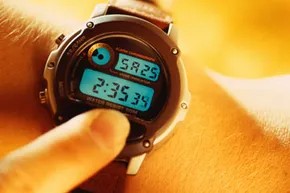
You look at your watch You don’t think about physics. You just want to know if you are late. However, if the quartz inside doesn’t work, you will be late. If the display dies, you won’t know until you check the time.
Quartz and liquid crystal are not even in the same state. However, these are the backbone of digital watches. Without these, an ordinary watch would just be a bracelet.
What exactly is quartz?
Crystals are everywhere. Quartz is one of the most abundant minerals on earth. Scientists call it silicon dioxide. This can also be seen in jewelry. You see it in sandpaper. You also see it inside your phone and TV.
The secret is piezoelectricity.
When you press on the crystal, it creates an electrical charge. Put an electric charge into it, and it vibrates. This reverse piezoelectric effect is why quartz is so well suited for timekeeping. It needs very little power to keep moving.
Why do digital watches need a liquid crystal display?
Liquid crystals are different. They are not a single substance. They were first discovered in the 19th century. Scientists were studying cholesterol. They discovered the fourth state of matter.
Molecules are rod or plate shaped. They flow like a liquid. But they keep the alignment and order of solids. When light passes through them, their optical properties change. This makes them ideal for displays.
The first watch with an LCD screen was released in 1973. Since then, LCD screens have replaced computers and televisions. Numbers are displayed on the watch’s LCD screen.
How does quartz tell time?
A digital quartz watch has five main parts. A timing mechanism is needed. You need a display. You need an integrated circuit. You need a battery. You need a circuit board.
This is not a mechanical watch. Mechanical watches must be wound. They use gears. They do not use quartz. Gears are also used in analog clocks. They do not usually use liquid crystals. Digital quartz watches use both.
Quartz is a timekeeper. Seiko introduced this in their watches in 1969 and it quickly became the standard.
The accuracy is high. The displayed time may vary by a few seconds per month. Why? This is because quartz has a very high vibrational frequency. It is piezoelectric, so it uses little power. A single alkaline battery can last for several years.
The battery transfers a small amount of electrical charge to the integrated circuit. This circuit is connected to the crystal oscillator via small electrodes. The current causes the crystal to vibrate.
Vibrations are standardized. Watch quartz oscillators vibrate 32,768 times per second. It is 32.768 kilohertz. The integrated circuit counts these vibrations. It measures the intervals. Seconds. Minutes. time.
At each interval, the circuit sends an electrical pulse. Where does the pulse go? To the liquid crystal display.
The reality of deviation
Industry standardizes vibration. But reality is messy. The oscillator vibrates a little more or a little less. It depends on the temperature. It depends on the pressure.
This watch is accurate enough for everyday use. But the deviations add up. Every month you can lose a few seconds. It’s not perfect. But it is good enough to get you to your next appointment.
How the screen works
The pulses of the integrated circuit hit the liquid crystal display. Liquid crystals change their arrangement. They block or let light pass through. This creates the numbers that appear on the watch face.
The process is silent. It is efficient. It is based on a strange dance between vibrating crystals and flowing liquids.
You check your watch. A number will be displayed. You should leave. You will never think about silica or cholesterol derivatives again. Until the battery runs out. Or the screen goes dark. Then you remember.
The technique is simple. Physics is complicated. The result is just a number.
Quartz records small moments that people cannot perceive. Liquid crystals transform this invisible rhythm into something we can read. One is measuring time. Another shows it. Together, these ensure that your schedule remains intact.
Liquid Crystal Twist
The LCD screens are oddly spaced. It is not very durable. There is less liquid. Its optical properties make it ideal for a twisted nematic (TN) display, which is the standard for most digital watches.
Within this screen, the molecules are arranged in a twisted spiral. Think of them as tiny corkscrews. Applying an electrical pulse (external force) breaks these bonds. This physical change changes the way light travels.
Between light and electricity
LCD screens are basically sandwiches. It has two pieces of glass. Both conduct electricity. Between them sits the liquid crystal chemicals.
This is the hard part. Each plate has a polarizing filter. The filters are oriented at an angle of 90 degrees from each other. Typically, the liquid crystal molecules are aligned parallel to these filters. The ambient light is reflected from the mirror below. The result? Silver reflective background. This is why watch face look metallic in the dark.
But apply an electric charge, and the molecules flip. They run perpendicular to the filter. Filters absorb all light. The cells turn black.
“When you add a charge to a liquid crystal display, the molecules change their orientation… leaving black cells on the screen.”
Count the seconds
Integrated circuits handle the heavy lifting. It receives time data from the quartz oscillator. This circuit sends electrical pulses at regular intervals such as every second, minute or hour.
These pulses tell the LCD screen which parts to turn on or off. The screen is divided into several parts. Most digits use a seven-segment layout. This displays the numbers 0-9. If you change one segment, three becomes two. A five becomes a six.
Some displays use 14-segment sections. These have more cells. They can show letters, not just numbers. However, when it comes to timing, seven-segment models prevail. This way you can read 12:15 one second and 12:16 the next.
An unlikely partnership
Quartz and liquid crystal are fundamentally different materials. Their purpose is completely different. Quartz oscillates. Liquid crystals block or transmit light.
But without this partnership we would be lost. Quartz provides the heartbeat. Liquid crystal provides the face. Without one, the other is just a ticking box or a blank screen.


