


The Middle East is undergoing a profound digital transformation, characterized by a massive surge in AI commercial activity, the rise of world-class smart cities, and a strategic push for sovereign technological infrastructure. From Saudi Arabia’s booming registration numbers to the UAE’s leadership in urban intelligence, the region is moving from AI adoption to deep integration across all sectors of the economy.
📈 The Economic Engine: Saudi Arabia’s AI Surge
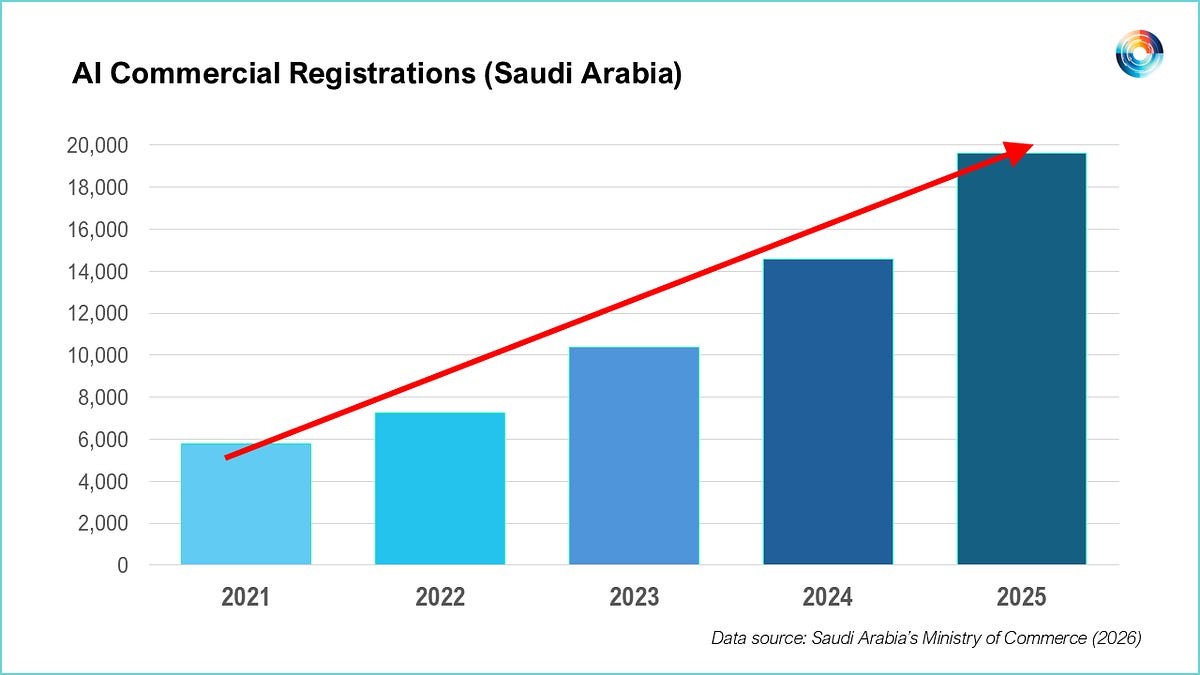
Saudi Arabia is rapidly cementing its position as a regional tech powerhouse. New data from the Ministry of Commerce reveals that commercial AI registrations have tripled in just four years, reaching 19,638 by the end of 2025.
This growth is not accidental; it is the result of a deliberate alignment with Vision 2030. By designating 2026 as the “Year of Artificial Intelligence,” the Kingdom is signaling to global investors that its commitment to a post-oil, tech-driven economy is permanent. This momentum is further supported by:
– Strategic Automation: 86% of Saudi enterprise leaders view automation as a prerequisite for scaling AI effectively.
– Regulatory Frameworks: The Saudi Data and AI Authority (SDAIA) is actively shaping the landscape through public consultations on responsible AI and new guides for “vibe coding” (generative programming).
🏙️ Urban Intelligence: The Rise of Smart Cities
The Gulf region is setting new global benchmarks for urban living. The IMD Smart City Index 2026 highlights the UAE as a global leader, with Dubai (6th) and Abu Dhabi (10th) topping the Arab world’s rankings.
The success of these cities is built on high levels of public trust and sophisticated digital governance. Interestingly, Saudi Arabia is also making significant strides, placing six cities in the regional top ten, indicating a massive wave of investment in smart urban infrastructure across the Kingdom.
🏗️ Infrastructure and Sovereignty: Building the Foundation
As AI moves from software to hardware, the region is investing heavily in the physical and digital “backbone” required to run large-scale models.
Data Centers and Sovereign Platforms
Morocco is positioning itself as a critical regional hub. The country has cleared land for a $1.2 billion AI data center near Casablanca, backed by industry giants like Nvidia and Naver Cloud. Additionally, the launch of Aba Fusion —a sovereign AI platform developed with NVIDIA and Dell—demonphasizes Morocco’s goal of maintaining control over its own data and computing power.
The Startup Ecosystem
Innovation is being accelerated through high-impact programs:
– UAE: Abu Dhabi’s Presight (G42) saw a massive surge in interest for its AI accelerator, receiving 376 applications from 62 countries.
– Oman: A new partnership between the Omani Ministry of ICT and Microsoft is providing startups with the Azure credits and mentorship needed to scale globally.
🛠️ Industry Deep Dives: Telecom, Defense, and Education
Telecom & Reliability
While AI shows promise, it is not without its hurdles. A new benchmark, TelcoAgent-Bench (developed by GSMA, AT&T, and Khalifa University), has identified a critical gap: while AI agents are excellent at diagnosis, they struggle with the complex execution of troubleshooting sequences, particularly in bilingual contexts. This highlights the need for rigorous validation before deploying autonomous network management.
Defense & Security
In Kuwait, the National Guard is modernizing its operations by building AI-powered military databases to enhance decision-making and intelligence workflows. Meanwhile, Qatar is focusing on the “safety” side of the digital shift, launching a cloud privacy assessment tool to help organizations protect data as cloud adoption accelerates.
Education & Workforce Development
To prevent a talent gap, regional players are scaling digital literacy:
– Egypt: The Digital Egypt Generations initiative has already trained over 277,000 people in AI and cybersecurity.
– Arabic-Language Content: Initiatives like WideBot’s Arabic AI education series are addressing a vital need: the shortage of high-quality, localized training data for Arabic speakers.
💡 Summary of Key Trends
The Middle East is transitioning from a consumer of global technology to a creator and regulator of its own AI ecosystem. This is evidenced by the massive investment in physical data centers, the push for sovereign AI platforms, and the rapid scaling of specialized AI workforces.
Conclusion: The region’s AI trajectory is defined by a dual focus: aggressive economic expansion through commercial registrations and a disciplined approach to building the necessary regulatory and physical infrastructure to sustain it.