



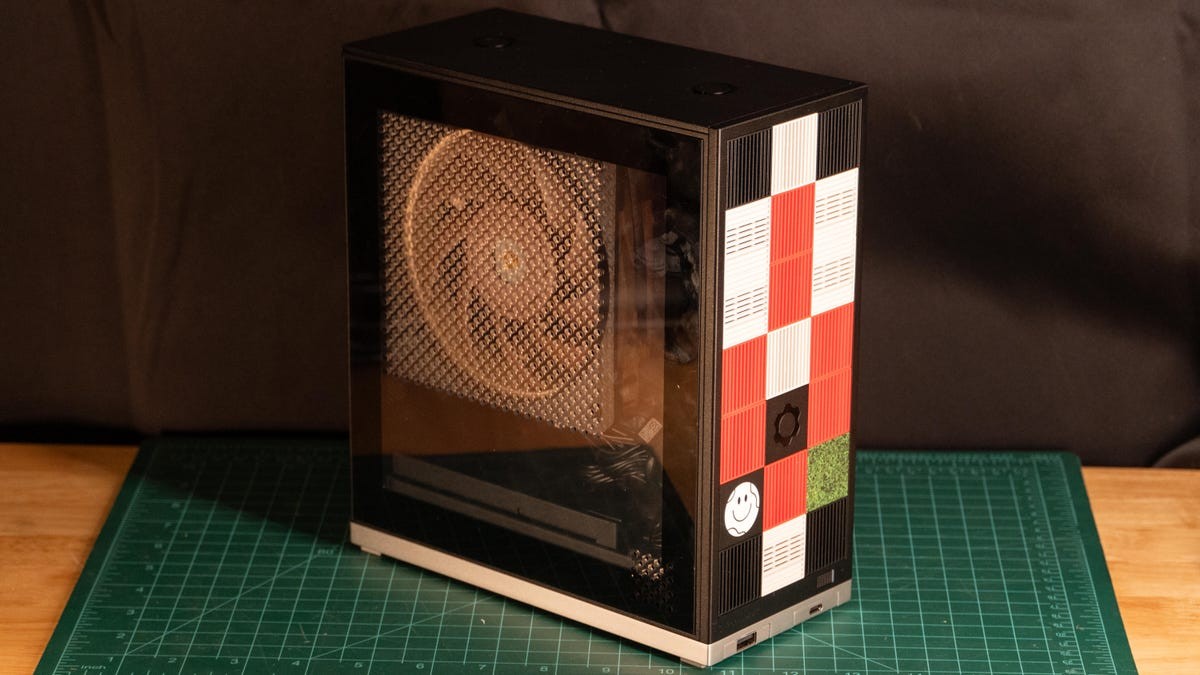
The Framework Desktop delivers surprising performance in an unusually small package, yet falls short of the full upgrade potential expected from the company. Its 4.5-liter form factor belies its capabilities, making it a compelling option for those prioritizing size over ultimate customization.
Performance and Capabilities
The Desktop houses an AMD Ryzen AI Max Plus 395 processor, integrated graphics, and up to 128GB of shared memory. This combination results in impressive benchmarks: a PCMark10 score of 8,715 suggests it rivals many high-end gaming PCs in everyday tasks. Single-core performance competes with recent Intel chips, while multi-core speeds exceed even some desktop configurations. The integrated Radeon 8060S GPU performs between a mobile Nvidia RTX 4060 and RTX 4070, capable of running demanding games like Shadow of the Tomb Raider at 1080p with high settings (averaging 111 FPS).
The system maintains consistent performance under sustained loads, and its shared memory architecture offers advantages in AI workloads by avoiding the need for expensive dedicated GPUs. Despite its compact size, the Desktop operates quietly even under stress.
The Cost of Compactness
Framework’s Desktop starts at $1,139 with a Ryzen AI Max 385 and 32GB of RAM. Upgrading to the tested Ryzen AI Max Plus 395 with 64GB increases the price to $1,639, while a 128GB configuration reaches $2,459. However, these prices exclude essential components : storage, an operating system, the CPU fan, expansion cards, front tiles, and even the power cord are sold separately. These additions can quickly inflate the final cost. A fully equipped test configuration costs $2,039 after adding a 1TB SSD, Windows 11 license, Noctua fan, clear side panel, and front I/O expansion cards.
The bare mainboard costs $839, suggesting the case and power supply contribute an additional $300 to the system price.
Limited Upgradeability: A Trade-off
The Framework Desktop is not as modular as the company’s laptops. While it features a PCIe 4.0×4 slot and two M.2 slots, its cramped interior and limited airflow restrict upgrade options. The plastic exterior feels cheap, and the decorative front tiles compromise cooling performance.
The I/O selection is also sparse: two USB 3.2 Gen 2 ports on the front, two 10Gbps USB-A ports and USB4 ports on the rear, one HDMI 2.1 port, two DisplayPort 2.1 ports, a headphone jack, and a 5GbE Ethernet port. The Minisforum AI X1 Pro provides comparable I/O with more convenient front access, an extra M.2 slot, and user-upgradeable memory.
Conclusion
The Framework Desktop is a capable mini-PC that excels in performance for its size. However, its limited upgradeability and high cost of entry, when factoring in necessary accessories, make it a niche product. While it performs well in both general and AI-focused tasks, prospective buyers should weigh these trade-offs against alternatives like Mini-ITX builds or more customizable mini-PCs.