



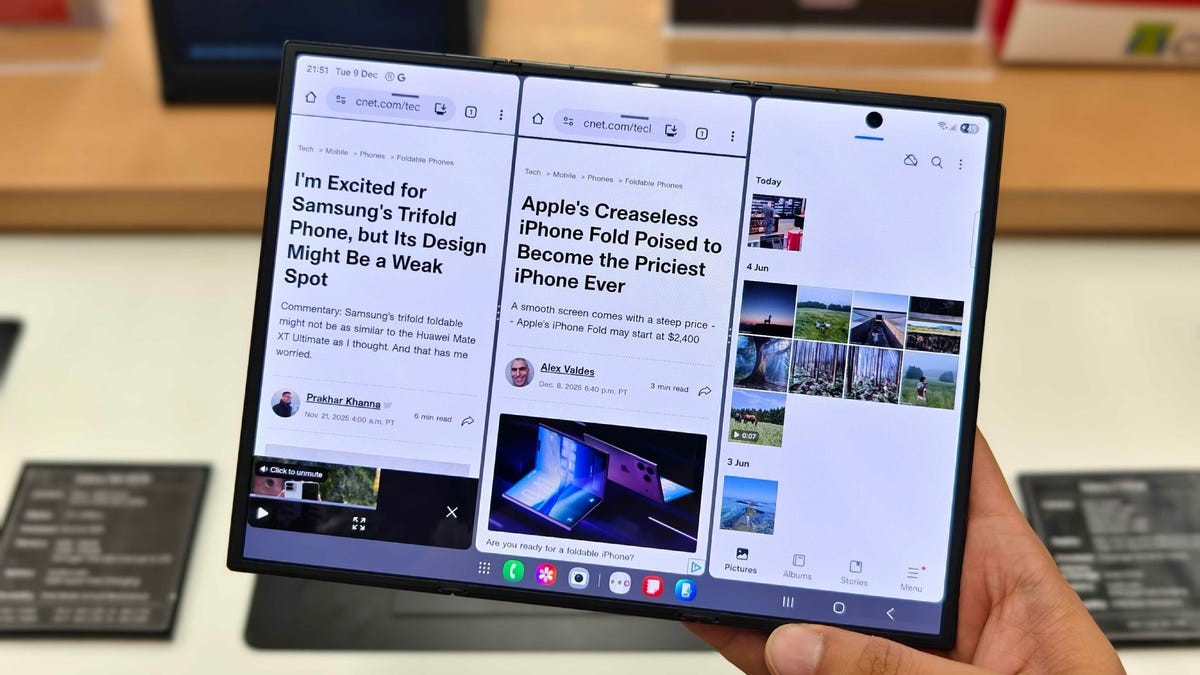
Samsung has begun selling its Galaxy Z TriFold, a smartphone featuring two hinges and a 10-inch inner display. The device is now available in the US, but at a price of $2,900, it enters a new bracket of smartphone expense. This launch precedes the expected arrival of the Galaxy S26 series next month.
The Price Point: The Z TriFold’s cost significantly exceeds other premium smartphones; it’s more than double the starting price of the Galaxy Z Fold 7 and over three times that of the Galaxy S25. This pricing strategy aligns with a broader trend of increasing costs across consumer electronics, particularly for foldable devices, which are positioned as ultra-premium products.
The Technology Behind the Cost
The Z TriFold unfolds to reveal a 10-inch inner screen, larger than the 8-inch display of the Z Fold 7. Its hinges, constructed from titanium, are rated to withstand 200,000 folds – a durability benchmark that speaks to the engineering behind the device. At its thinnest point, the phone measures 3.9mm, though Huawei’s Mate XT trifold beat Samsung to market by a year with a 3.6mm thickness, though it is not available in the US.
The Z TriFold runs on the Snapdragon 8 Elite chip, which powered the Galaxy S25 series. It will not feature the newer Snapdragon 8 Elite Gen 5 expected in upcoming flagships, like the S26. Battery capacity is at 5,600 mAh, larger than the Z Fold 7’s 4,400 mAh, but charging speeds remain at 45 watts, lagging behind competitors like OnePlus’ 80-watt charging. The camera system includes a 200-megapixel main sensor, alongside a 12-megapixel ultrawide and a 10-megapixel telephoto lens. The phone is available in a single “crafted black” color.
Competition and Alternatives
Huawei’s Mate XT offers a comparable tri-fold design, but at an even higher price (around $4,150) and with potential compatibility issues for US carriers. The EMUI operating system and the absence of Google apps may also deter Android users.
Is the Upgrade Worth It?
Despite its technical advancements, the Z TriFold offers only incremental improvements over the Galaxy Z Fold 7. Its hardware will likely be surpassed by the upcoming Galaxy S26 series. The primary advantage remains its larger display, which may not justify the steep price for most consumers.
The $3,000 price tag of the Z TriFold seems to be more about exclusivity than tangible value for the average user.
The device is positioned toward consumers who prioritize cutting-edge technology over practicality. While technically impressive, it remains to be seen whether the Z TriFold will establish a new norm in smartphone pricing or remain a niche luxury product.