



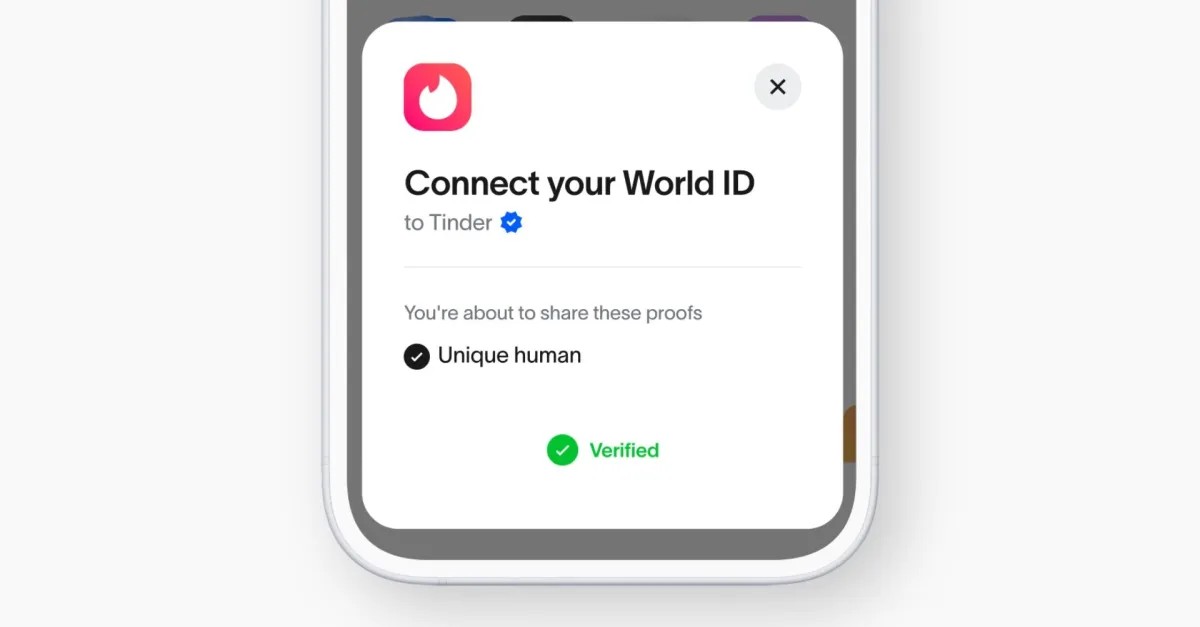
Dating apps are increasingly fighting a losing battle against bots and AI-generated profiles. In a new move to combat digital impersonation, Tinder is partnering with World —a project co-founded by OpenAI CEO Sam Altman—to offer incentives to users who prove they are biologically human.
How the Verification Works
To participate in this new verification tier, users cannot simply upload a selfie or a government ID. Instead, they must physically visit a World “orb” —a specialized hardware device designed to perform high-resolution facial and iris scanning.
The process functions as follows:
– Physical Presence: Users must visit an orb in person to undergo a scan.
– Biometric Capture: The orb captures images of the user’s face and eyes.
– Data Privacy: According to World, this biometric data is encrypted and stored on the user’s phone, theoretically ensuring that the individual maintains control over their own identity.
– Digital Badge: Once verified, users receive a “verified human” badge on their Tinder profile, distinguishing them from potential AI agents or bots.
The Incentive: Why Users Might Step Out of Their Way
Because physical verification requires a trip to a specific location, Tinder is offering a limited-time incentive: five free “boosts.” A boost increases a user’s visibility within the app, making them more likely to appear in others’ discovery feeds.
While Tinder already offers traditional verification methods—such as photo or government ID checks—the specific rewards and the “verified human” status are currently reserved exclusively for those using the World ID system.
The Bigger Picture: A Growing “Proof of Personhood” Trend
This partnership is not an isolated experiment. World is expanding its footprint beyond dating, integrating its “proof of human” technology into major professional platforms like Zoom and DocuSign. To manage these connections, the company is also launching a dedicated World ID app, separate from its broader “World super app” ecosystem.
This shift highlights a growing technological tension: as generative AI makes it easier to create convincing fake personas, companies are looking toward biometric hardware to establish a “digital baseline” for humanity. The integration into Zoom and DocuSign suggests that the goal is to create a universal standard for identity that can be used to secure everything from video calls to legal signatures.
The move signals a shift in digital identity, moving away from passwords and toward physical, biometric proof to safeguard human interaction in an AI-driven world.
Conclusion
By linking biometric verification to tangible rewards, Tinder is testing whether users are willing to trade physical effort for digital authenticity. As AI continues to blur the lines between human and machine, the demand for verifiable “proof of personhood” is set to become a standard feature of the digital economy.