




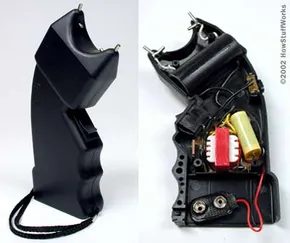
Forget the Hollywood explosions. A conventional stun gun is surprisingly low-tech. It looks like a flashlight. It runs on standard 9-volt batteries. That’s it. The magic happens inside.
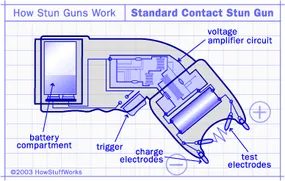
The battery feeds power into a circuit. This isn’t just a wire loop. It’s a complex web of components designed to do one thing: boost voltage. Transformers step up the power. We’re talking 20,000 to 150,000 volts. The amperage drops, though. High voltage, low current. That distinction matters.
An oscillator plays a key role. It fluctuates the current. This creates a specific pulse pattern. Electricity doesn’t just flow; it pulses. That pulse charges a capacitor.
The capacitor stores the charge. It builds up potential energy. Then it releases it all at once. The energy travels to the electrodes. These are the “business end” of the device. Two metal tips. When you press them against a target, the stored charge jumps the gap. ZAP.
The core mechanism relies on stepping up voltage to extreme levels while keeping amperage low, using an oscillator to create pulses that charge a capacitor for immediate discharge.
This design has been around for decades. It’s simple because it doesn’t need to be complex. A 9-volt battery is cheap. Transformers are cheap. The result is a device that delivers a shocking experience without the danger of lethal current. It’s about control. And pain. Not permanent damage. Usually.

How Taser Electrodes Deliver Voltage
The mechanics are brutally simple. Inside the device, you have two metal plates acting as electrodes. They sit in the circuit with a gap between them. Because of that gap, there is a massive voltage difference building up on either side. It’s waiting for a bridge.
If you fill that gap with a conductor—say, the attacker’s body—the circuit closes. The electrical pulses don’t just stop. They rush from one electrode to the other. But they don’t take the path of least resistance. They dump electricity directly into the nervous system of whatever is in the way.
The electrical pulses will try to move from one electrode to the other, dumping electricity into the attacker’s nervous system.
This isn’t about shock value. It’s about override. The external electrodes force the body’s electrical signals to short-circuit. Muscle control is replaced by the device’s signal. That’s why the target goes down. The voltage difference is the engine. The conductor is the fuel. The nervous system is the casualty.