




search engine. Use these to find recipes, debug your code, or find out why your Wi-Fi is slow. But when you type a query into Google, Bing, or any other major engine, you’re not just searching “the Internet.” You are searching the World Wide Web. This distinction is important because the Internet is an infrastructure. The web is the layer of content above it.
Before the Web took over in the ’90s, finding information online was a pain. Programs such as Gopher and Archie index files on the server. They cut down search time, sure. But you had to know what you were looking for and how to navigate the early, clunky interfaces. In the late 1980s, if you wanted to get real value online, you had to master Gopher, Archie, or Veronica. Most people don’t. They just want to click and see the results.
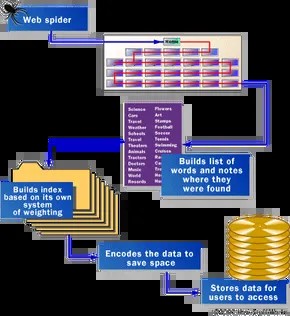
Today, the focus is almost exclusively on Web pages. To make that happen, search engines use specialized software robots. We call them spiders.
How Web Indexing Works
When spiders search the web and create a list of words, this process is technically called web crawling. This name leans heavily on spider-centric metaphors, as naming conventions in the tech industry favor novelty over clarity.
The scale is hard to wrap your head around. There are hundreds of millions of pages. Spiders can’t read everything at once. It has to start somewhere.
Usually, it starts with the heavy hitters. A list of popular servers and pages with a lot of traffic can serve as a starting point. The spider lands on the main site, indexes the words and follows all the links it finds. From there, it spreads out. It moves laterally across the most connected and most used parts of the network. It’s a ripple effect. One popular page points to another page and another page points to another page. Spiders don’t need maps. It builds its own path by following hyperlinks.
Google’s Early Engine: Speed as a Feature
To understand modern crawlers, we need to understand how the giants got their start. Google started as an academic project. Sergey Brin and Larry Page didn’t just want a search engine. they wanted a fast one.
In their seminal paper, they presented an early system designed for pure speed. They didn’t run one spider. They ran multiple. Usually three. Each spider can maintain about 300 open connections to web pages at the same time.
When these four spiders reached their peak, the system was crawling over 100 pages per second. It’s not just fast. That’s aggressive. It produces about 600 KB of data per second.
Speed isn’t free. Infrastructure is needed. Google’s early setup had a specific server to feed URLs to the spiders. Why? This is because the DNS name server of a standard ISP translates a name into an IP address with a delay. When indexing millions of pages, a delay of even a few milliseconds accumulates. Google built its own DNS to bypass that bottleneck.
What do spiders really see?
When the Google spider lands on an HTML page, it doesn’t “read” the page like a human does. It parses structure. It notes two critical things.
- Words on a page.
- Where those words are located.
Location dictates weight. The words in the title, subtitle and meta tags are especially taken into account in user searches. The spider also removes “stop words” such as “a”, “an” and “the”. Although common, these are rarely useful in distinguishing one document from another.
Not all spiders follow these rules.
Some systems, like Lycos, try to optimize speed and efficiency by focusing only on the most important text. Track titles, subtitles, links and words in the first 20 lines of content. We also pay special attention to the most frequently used word on page 100. It’s a heuristic approach. It assumes that beginning and structure are most important.
AltaVista took the opposite route. It indexes every word. Contains “a”, “an” and “the”. The logic here is perfection. When a user searches for a phrase that contains a stop word, AltaVista may detect it. This approach requires more storage and processing power, but the goal is completeness, not speed.
Why are the search results different?
This difference in strategy explains why different search engines return different results for the same query. It’s not just about who has the biggest index. What matters is what you decide to index and how you assess relevance.
Some spiders prefer visible text. Others explore invisible metadata. Some ignore closing words to save space. Some keep them to record exact phrase matches.
The battle between speed and integrity is far from over. It just evolved. Modern engines use a hybrid approach, using machine learning to guess which words are important before you hit enter. However, the core mechanism remains the same. The spider fell. Follow the link. Create a list. You will get an answer.
Currently, the network is still too large to be fully mapped. The spider is still running. They keep finding new pages faster than we can create them.