



You probably have ten of them in your home right now. A ceiling fan. A fridge compressor. The hard drive spinning in your laptop. The window blinds. Almost every mechanical movement you see is driven by an electric motor. We’re talking about two main types: AC (alternating current) and DC (direct current).
Understanding the mechanics behind these devices offers a crash course in electromagnetism. At its core, an electric motor is just a machine that uses magnets to create physical motion. If you’ve ever played with fridge magnets, you know the basic rule: opposites attract, and likes repel.
Take two bar magnets. Mark one end “north” and the other “south.” The north end of Magnet A will pull toward the south end of Magnet B. But if you try to push the north end of Magnet A against the north end of Magnet B? They push back. That repulsion is key. Inside a motor, these constant cycles of attraction and repulsion generate rotational motion.
Inside an Electric Motor
The Magnetic Core of Motor Action
You can’t really grasp how an electric motor functions without first getting comfortable with the electromagnet. If you need the nitty-gritty on those, there are deeper dives available. But here is the baseline: the electromagnet is the engine’s beating heart.
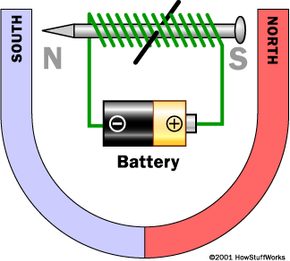
Imagine a simple setup. Take a nail. Wrap one hundred loops of wire around it. Connect that wire to a battery. Instantly, the nail transforms. It gains polarity—a north pole and a south pole. It is no longer just metal; it is a magnet. But this only lasts as long as the current flows.
Now, take that energized nail. Thread an axle through its center. Suspend it right in the middle of a stationary horseshoe magnet. This is where the physics gets interesting. Connect the battery to your nail-electromagnet. Align it so the north end of the nail faces the north end of the horseshoe magnet.
Basic magnetism takes over. Like poles repel. The north end of your nail gets shoved away by the horseshoe’s north pole. Simultaneously, it gets pulled toward the horseshoe’s south pole. The south end of the nail experiences the same push-pull dynamic in reverse.
The result? The nail twists. It rotates half a turn. Then, it stops dead.
It sits there. Stuck in equilibrium. The magnetic forces have balanced out. If you leave it like this, nothing else happens. No continuous motion. Just a twitch and a halt. This is why a simple loop of wire in a static magnetic field isn’t a motor. It’s a lock. To make it spin, you have to switch the polarity. You have to cheat the magnet.
The secret to making an electric motor actually turn isn’t just about magnetism—it’s about timing. Specifically, you need to flip the magnetic field of the electromagnet exactly when the rotor completes a half-turn. Without this switch, the motor stalls. It’s a simple concept, but the execution requires precision.
The Mechanics of Reversal
To reverse the magnetic field, you have to reverse the direction of the electron flow through the wire. In a theoretical setup, this is as easy as flipping the battery over. When you do that, the polarity of the electromagnet changes. The north becomes south, and the south becomes north.
This change in polarity pushes and pulls the rotor’s permanent magnets again. Instead of resisting motion, the electromagnet now helps it along. It completes the next half-turn of rotation.
Why Timing Matters
Imagine if the field never flipped. The rotor would swing toward the electromagnet, get stuck, and stop. You’d have a paperweight, not a motor. But if you flip the field at the precise moment the rotor reaches the end of its swing, the attraction turns into repulsion (or vice versa, depending on the design), pushing the rotor forward into the next half-turn.
Do this continuously, and the electric motor spins freely. It doesn’t need external force. It sustains its own motion through magnetic switching.
The Real-World Solution: The Commutator
Flipping a battery manually doesn’t work for a spinning motor. That’s why real DC motors use a commutator —a split ring attached to the rotor—and brushes that maintain contact with the spinning commutator.
As the rotor turns, the brushes slide across the commutator segments. At the exact moment the rotor aligns with the stator’s magnets, the brushes switch from one segment to the other. This physically reverses the current direction in the coil without anyone touching a battery. The magnetic field flips automatically. The cycle repeats. Thousands of times per second.
The commutator acts as a mechanical switch, reversing current direction to keep the torque unidirectional.
Why DC Motors Still Matter
You might think this mechanical switching is outdated. After all, modern EVs and appliances often use AC or brushless DC motors. But simple DC motors with commutators are everywhere. Toys. Power tools. Household appliances. They’re cheap to manufacture, easy to control, and robust.
The trade-off? Wear. The brushes and commutator create friction. They spark. They wear down over time. That’s why brushless motors dominate in applications where longevity and efficiency are critical. But for low-cost, high-torque startup needs, the brushed DC motor remains hard to beat.
Efficiency and Control
Controlling speed in a DC motor is straightforward. Increase the voltage, and the motor spins faster. Reverse the voltage polarity, and it spins backward. This simplicity makes them ideal for robotics and automation where precise, bidirectional control is needed without complex electronics.
But there’s a catch. Energy loss. The electrical resistance in the wires, the friction in the brushes, and the magnetic hysteresis in the core all convert useful energy into heat. Efficiency rarely exceeds 70-80% in small motors. Larger industrial DC motors can do better, but they’re massive and expensive.
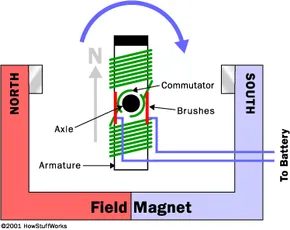
The DC Motor Anatomy
Let’s get the terminology straight first. The text calls DC “the latter” but lists it before AC. That’s a typo in the source. Direct Current (DC) motors date back to the mid-1800s. They are still everywhere. Alternating Current (AC) motors exist too, but we are talking about DC here.
A basic DC motor has six distinct components. You need to know them if you want to understand why your toy car moves or why your laptop fan spins.
- Stator
- Rotor
- Commutator
- Brushes
- Axle
- DC power supply
The stator is the outer shell. It doesn’t move. It holds a permanent magnet. Think of it as the stationary horseshoe magnet from a physics demo. The rotor sits inside. It moves. It acts like the nail in that same demo.
When DC power hits the rotor, something happens. The electricity turns the rotor into an electromagnet. This temporary magnetic field clashes with the permanent field of the stator. Opposites attract. Like poles repel. The rotor tries to align with the stator. But it doesn’t stop there.
Enter the commutator. Its job is to flip the polarity of the rotor’s field. It switches the direction of the current at just the right moment. This keeps the magnetic fields pushing against each other instead of locking into place. The result? Continuous rotation. Torque. Mechanical power.
Toy Motor
This principle powers almost every cheap electric toy. The commutator and brushes take the hit here. They wear out. They spark. They are the weak link in the chain. But for a simple toy motor, they work. You flip a switch. Power flows. The rotor spins. The car moves. It’s crude. It’s efficient enough. And it has been for over a century.
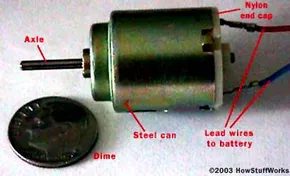
Inside the Tiny DC Motor
Look at the motor in the picture. It is small. About the size of a dime. There are just two leads for the battery. Connect them. The axle spins. Reverse the leads. The axle spins the other way. Simple. But inside that plastic shell, there is a lot going on.
The nylon end cap stays put because of two tabs. Inside, things get mechanical. The motor’s brushes touch the commutator. They transfer power from the battery as the motor turns. This is where things wear out. Brushes degrade. They need replacing. That is why modern DC motors often ditch them. Brushless designs are more durable.
The axle holds the rotor. It also holds the commutator. The rotor is a set of electromagnets. In this specific motor, there are three. The armature consists of thin metal plates stacked together. Copper wire coils around each of the three poles. You have two ends per wire. One for each pole. They attach to a terminal. Then, each of the three terminals wires to one plate of the commutator.
Then there is the stator. Every DC motor has one. Here, it is the can itself. Plus two curved permanent magnets. In DC motor terminology, the armature is the rotor. The field is the stator. It is a magnetic dance.
Rotor, Commutator and Brushes
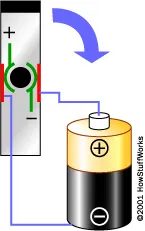
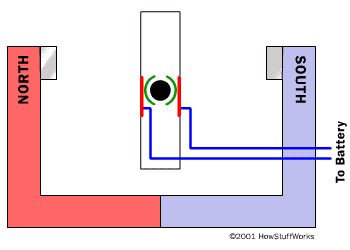
The rotor acts as the spinning heart of the system. Attached directly to its axle is the commutator. Think of it not as a complex mechanism, but as a simple pair of plates. These plates serve a singular, critical function: they provide the two necessary connection points for the coil of the electromagnet inside the rotor.
But how does the current keep pushing the rotor forward instead of letting it stall? That’s where the magic of flipping the electric field happens. This process relies on a handshake between two components: the commutator and the brushes.
In visual diagrams, the commutator often appears in green while the brushes are red. They work in tandem to guide current into the electromagnet. More importantly, they switch the direction of electron flow at the precise millisecond needed to maintain momentum. The commutator’s contacts are bolted to the axle, meaning they spin alongside the magnet. The brushes, meanwhile, are stationary. Usually made of springy metal or carbon, they press against the spinning commutator contacts, maintaining electrical continuity without friction-induced chaos.
Putting It All Together
Stack these components, and you get a complete electric motor. The logic is deceptively simple. As the rotor passes the horizontal midpoint, the poles of its electromagnet flip. This flip ensures the north pole of the rotor is always positioned above the axle. Why? So it can repel the stator’s north pole and attract the stator’s south pole. Continuous repulsion and attraction equal continuous rotation.
You might notice most motors don’t just have two poles. They usually have three poles. This isn’t arbitrary. There are two practical reasons for moving to a three-pole design:
- Stalling issues. In a two-pole motor, if the electromagnet starts perfectly horizontal—balanced exactly between the stator’s poles—it has no torque to kickstart itself. It just hangs there. A three-pole motor eliminates this “dead center” problem.
- Energy waste. Every time a two-pole commutator hits the flipping point, it briefly shorts out the battery. That’s wasted energy. A three-pole setup smooths this out, preventing unnecessary battery drain.
While three poles are standard for small motors, the number isn’t fixed. You can have any number of poles depending on the motor’s size and job description.
How an AC Motor Works
Switch gears to alternating current, and the rules change slightly. AC motors don’t use DC. They share the basic anatomy of stators, rotors, and axles, but the internal choreography is different.
The parts list looks familiar:
- Stator
- Rotor
- Solid axle
- Coils
- Squirrel cage
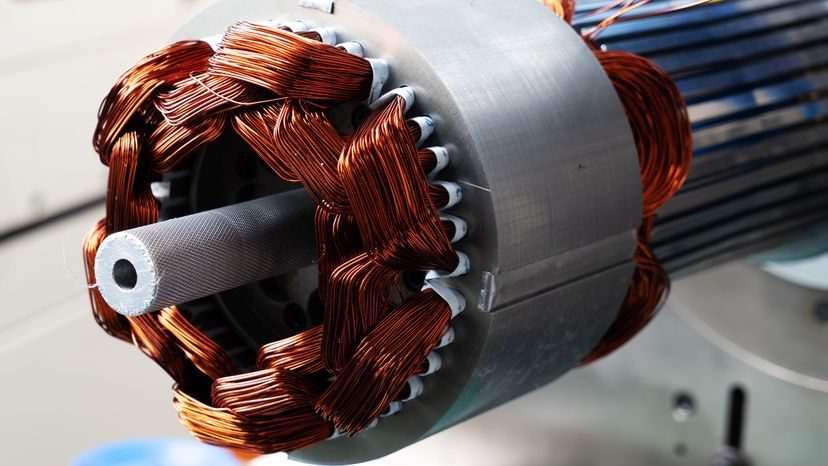
Here, the stator’s winding takes on the role that the rotor played in the DC version. Instead of a single spinning magnet, the stator becomes a ring of electromagnets. These are paired up and energized in sequence. This sequential firing creates a rotating magnetic field. The rotor, often a simple “squirrel cage” of conductive bars, follows this field like a dog chasing a tail it can never quite catch.
It’s all about timing. In a DC motor, we use brushes to flip the field. In an AC motor, the field itself rotates, dragging the rotor along in its wake.
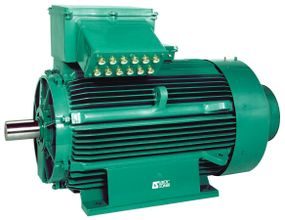
You already know that a DC motor’s rotor is wired straight to a battery. It’s a direct line. An AC motor? Totally different beast. No direct power connection. No brushes sparking away. Instead, it relies on a squirrel cage rotor. Yes, that’s the actual name. It sounds like a pet toy, but it’s the heart of most efficient electric motion we use daily.
How the Squirrel Cage Actually Spins
The squirrel cage isn’t a literal cage for rodents. It’s a cylinder made of sturdy aluminum or copper bars. These bars are short-circuited at both ends by heavy metal rings. It looks like a hamster wheel designed for a very heavy, very hot hamster. This assembly sits inside the stator—the stationary outer shell.
Here’s the trick. When you plug an AC motor into the wall, alternating current flows through the stator’s windings. This creates a rotating magnetic field. The squirrel cage rotor is just a bunch of conductors sitting in that field. As the magnetic poles flip back and forth, they induce a current in the rotor bars. That induced current creates its own magnetic field. The two fields interact. The rotor gets pushed. It spins.
It’s induction. The rotor never touches the power source. It just reacts to the magnetic ghost of the AC current.
The Chase for Stasis
In an AC induction motor, the rotor is always playing catch-up. The stator’s magnetic field spins at a specific frequency determined by the power grid and the motor’s design. This is called the synchronous speed. The rotor chases it. It gets close. But it never quite catches it.
If the rotor spun at the exact same speed as the stator’s field, there would be no relative motion. No changing magnetic flux. No induced current. No torque. The rotor must lag slightly behind. This difference is called “slip.” It’s not a bug. It’s the feature that makes the thing work.
The rotor spins to find a steady state of equilibrium that always stays just out of reach. That friction of effort creates torque. Torque turns wheels. Torque spins fan blades.
Wound Rotors vs. Squirrel Cages
Not all AC motors use the squirrel cage. Some use a wound rotor. This version has actual wire windings on the rotor, similar to a DC motor’s armature. These windings connect to slip rings and external resistors via brushes. You can adjust the resistance to control speed and starting torque.
But that complexity adds cost and maintenance points. Brushes wear out. Slip rings corrode. The squirrel cage is sealed. Solid. Indestructible. That’s why you see it in 90% of household appliances. One moving part. Fewer breakables. Less maintenance. Just spin and go.
Motors Are Everywhere (And You’re Ignoring Them)
Look around your kitchen. That fan above the stove? Motor. The blender blades? Motor. The microwave turntable? Motor. Even your refrigerator is a motor-heavy zone. It needs one to drive the compressor (squeezing the refrigerant), one to spin the internal fan (cooling the air), and sometimes another tiny one for the ice maker mechanism. That’s three distinct AC motors working in silence right now.
The utility room is a motor graveyard. The dryer drum? Motor. The furnace blower pushing hot air? Motor. The vacuum cleaner sucking dirt? Motor. Even cordless tools like electric screwdrivers and drills use DC motors, but the charging station and the base unit often rely on AC conversion or small AC components.
Bathroom? The exhaust fan. The hair dryer (yes, the fan that pushes air, not the heating element). The electric toothbrush (usually a tiny DC motor, but often charged via AC induction). The electric razor.
Your car is a rolling motor factory. Power windows. Power seats. Radiator cooling fans. Heater blowers. Windshield wipers. The starter motor that cranks the engine. And if you buy an EV? The main drive unit is likely an AC induction motor or a permanent magnet synchronous motor, powered by DC batteries through an inverter.
Computers. Phones. Toys. Garage door openers. Aquarium pumps. Almost any mechanical movement in your life is being pushed by an electric motor. We just don’t see them because they’re hidden inside plastic shells, humming away.
The DC to AC Bridge in Electric Vehicles
This brings up a common confusion. Electric cars use batteries. Batteries output Direct Current (DC). But many EVs use AC motors for their drive units. How does that work?
You don’t plug a DC battery directly into an AC motor. It won’t spin. You need a converter. Specifically, an inverter. The inverter takes the steady DC flow from the battery pack and chops it up, flipping it back and forth into Alternating Current (AC). It controls the frequency and voltage to control the motor’s speed and torque.
So the battery is DC. The motor is AC. The inverter is the translator. Without it, the car stays parked.
Frequently Asked Questions
How does a toy electric motor work?
It’s a miniature version of the standard DC motor. It uses two small permanent magnets, a commutator, brushes, and an electromagnet coil. It’s simple, cheap, and works on the exact same principles as the motor in your blender, just scaled down to fit in a Hot Wheels car.
What is a DC electric motor?
It converts Direct Current electrical energy into mechanical rotation. The key difference from AC motors is the commutator and brushes, which physically switch the current direction in the rotor to keep it spinning.
What are the parts of a simple motor?
Break it down. You need an armature (the rotor), a commutator, brushes, an axle, a field magnet (either permanent or electromagnet), and a power supply. That’s the six-part skeleton of basic electric motion.
How long can an electric motor last?
Under normal conditions, a well-maintained industrial motor can run for 15 to 20 years. Home appliances might last less due to heat cycles and usage intensity, but the core components are incredibly durable. The bearings usually go first.
Is a DC or AC electric motor better?
It depends on the job. AC motors are generally more powerful, robust, and require less maintenance because they lack brushes. DC motors can be more efficient in specific speed-control applications and offer high starting torque. Most household appliances prefer AC for its reliability. Industrial robotics often prefer DC or specialized AC servo motors for precision.
There’s always a motor somewhere, humming in the background, turning energy into motion. You just have to listen for it.