


You look at your phone. You glanced at your laptop. You check the TV. Your eyes will be glued to the LCD, LED or plasma screen. It is often forgotten that paper began as the original high-tech display.
Chinese inventors created it in 105 AD. This invention forever changed the way people communicate. Without paper, books would still have been silk scrolls. Only the wealthy could afford literacy. Everyone else is in the dark.
Paper is everywhere these days. You can’t escape it. About 280 million tons of paper were consumed around the world this year. This figure is estimated by the National Association of Paper Merchants in England. This is equivalent to 56 trillion sheets of letter-size bond paper. That’s a staggering amount of dead tree matter.
For 2000 years, ink on paper was the only way to display text and images. It still wins on portability. It still wins on price. And no power cord is needed. However, paper also has its disadvantages. Once printed, it cannot be altered without leaving evidence behind. You can’t carry about a thousand books in your pocket.
Scientists are fixing that. They are developing e-ink. This technology is expected to replace paper. You can now carry your library with you with a thin and light device. It could also make computer displays cheaper. Here is how the magic works.
How e-ink works
E-ink is not magic. This is physics and chemistry. It is based on microcapsules. These capsules are small. They contain charged pigment particles. These particles move when you apply an electric field.
Think of it as a group of people. Some were wearing black shirts. Some are wearing white shirts. When you push them one way, the black shirts face out. Push in the opposite direction and the white shirt will turn inside out. You can change the display by changing the direction of the field.
This creates a static image. It looks like printed paper. But unlike paper, it stays there without power. The image persists. You can turn the pages. You can also turn them off. Save energy.
Why it matters to everyday users
You might think this only applies to e-readers. it is not. The application range of electronic ink is expanding even further. It could replace glass screens. The glass breaks. Electronic ink does not. It is flexible. Very durable.
For students, this means one device instead of 10 heavy textbooks. For travelers, this means less weight. For the planet, this means less paper waste. The environmental impact is significant. We stop cutting down forests. We stop shipping heavy books across oceans.
The technology is very close. It’s very close. We are on the brink of a new era. Paper will not disappear overnight. But it is no longer the king of information. E-ink is on the rise. It is quiet. It is low energy. And it is waiting to take your book.

E Ink and Xerox are competing to define the future of display technology, but their approaches to developing electronic ink reveal interesting differences in design philosophies. Both companies are based in major tech hubs in Cambridge and Palo Alto, but the real story lies in the chemistry inside the ink bottles.
On the surface, this electronic fluid looks just like regular printer ink. It’s dark. It’s a liquid. But look closer and you’ll see a complex system designed to rearrange itself on command. The core mechanism is based on three common components:
- Microcapsules (or cavities) act as individual pixels.
- Ink or an oil-based suspension fills these cavities.
- Microspheres containing negatively charged dyes float in suspension.
This is not magic. This is electrostatics. This ink can be applied to flexible substrates in the same way as ordinary inks on paper. In digital books, these substrates are very thin plastic sheets. The entire page is covered with this ink and divided into grids like graph paper. Each cell works as a pixel and is connected to microelectronics embedded directly in the plastic sheet.
By applying a special charge to these microelectronic devices, the system manipulates the microcapsules to form text or images. The result is a display that does not require a backlight.
E-ink technology: beach ball and ping pong ball
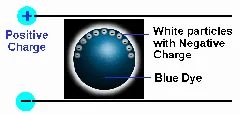
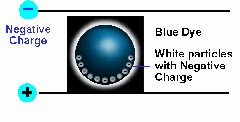
E Ink explained its technology with a simple analogy and explained why electronic paper does not emit light. Imagine millions of transparent beach balls. Each ball is filled with hundreds of tiny white ping pong balls and blue liquid dye.
If you look at the top of the beach ball, you can clearly see a white ping pong ball on the surface. The ball looks white.
When viewed from below, the blue dye is dominant. The ball is blue.
This is the essence of the E Ink method. When given a positive charge, the negatively charged white spheres floats to the surface. Reversing the charge causes the blue dye to appear. The pixels change color depending on which component is pushed in front. Since it is a bistable display, it can hold an image without consuming power.
At the same time, Xerox chooses another path. While the basic goal is to electrically rearrange the particles, the approach to achieving high-contrast, fast-refresh displays differs from E Ink’s bead-and-liquid model. Their focus to date has been on integrating these technologies into larger document workflows and specialized displays.
Why this matters to everyday users
The differences between these technologies are not just academic. It affects the way we read. E Ink is designed to prioritize readability in bright sunlight and battery life. The beach ball analogy explains why e-paper looks like paper. No light is emitted. Reflects ambient light.
For users, this means the device will last for weeks on a single charge. It also means that your eyes won’t get tired even if you read for a long time. This technology is not designed to create a vibrant, high-refresh-rate gaming display. It’s about creating a persistent, paper-like user interface for text.
The gap between digital and physical paper continues to narrow as both companies refine their methods. The ink is already here. The question is no longer whether it works, but who owns the standard.

Creating digital pages using E Ink and Xerox
Imagine a field with thousands of beach balls. Now imagine a small ping-pong ball moving between the top and bottom of these balls. The color of the field changes. This is the basic principle of E Ink display technology.
The reality is much smaller. These microcapsules are only 100 microns wide. One square inch holds about 100,000 pieces. Each capsule contains hundreds of dye fragments. Early prototypes used white chips and blue ink. The goal is a multicolor display.
Electrical charge determines where the chips goes. They either rise up or sink down. Top? White. Bottom? What the viewer sees is dark ink. The text is created with a pattern of white and dark colors.
Xerox is building its own version. They call it e-paper. The development started in the 1970s. We use microscopic balls instead of floating paint chips. The other side is black. The other is white. An electrical charge rotates the ball. The page changes from black to white. Xerox manufactures rubber sheets for Digital books. There are small balls floating in an oily liquid.
Wiring challenge
Creating an e-book is difficult. The page must be wired for an electrical charge. The pages should remain paper thin. E Ink is a pioneer in this field. They signed a contract with Lucent Technologies. Grants the right to use a plastic transistors. These small parts are printed directly on the page. These provide the electrical charge the e-ink chip needs to change colors.
The holy grail of digital reading
The dream is an e-book that can be formatted automatically. Readers turn pages just like regular paper. You read “The Old Man and the Sea”. Then you can download “Harry Potter” wirelessly. E Ink CEO Jim Iuliano predicted this in 2003 or 2004.
Xerox plans to install storage devices on the spine. Users can switch between up to 10 books stored on their device.
This changes more than just the book. It is also possible that the distribution of newspapers will stop. No more throwing paper out the car window. A high-tech delivery man presses a button. Every morning, thousands of electronic newspapers are updated simultaneously. It looks like paper. It feels like paper. There are no stains. There is no recycling bin.
Outside the book: Phones and Signs
Before the advent of digital books, E Ink’s target markets were mobile phones, PDAs, pagers and digital watches. Motorola provided financial support. E-ink has three advantages compared to current displays:
–Low power consumption
–Flexibility
–Readability
E Ink launched its first product, the Immedia large-area display, in 1999. These signs consume only 0.1 watts of power. A 100 watt light bulb can powers 1,000 signs.
In handheld devices, e-ink consumes 50–100 times less power than LCD screens. Power is only consumed when the display changes. E-books allow you to view the same text without a charge for several weeks.
The ink can be used to print on any surface. Walls. Billboards. product label. T-shirt. Homeowners can change their digital wallpaper using signals. Flexibility allows roll-up displays for electronics.
Readability and resolution
E-ink is easier on the eyes. Mimics printed text. Xerox and E Ink require higher resolution to allow for smaller prints. Xerox monitors have a score of 200 dpi. This is double the resolution of a standard LCD screen. Lucent’s printable transistors should help E Ink match the resolution of printed books.
Developers don’t expect people to throw away paper and screens right away. E-ink works in parallel with traditional methods. The impact on the publishing industry could see a multibillion-dollar impact.


