




You check the weather every morning. You swipe open an app or tap a widget, see if you need an umbrella, and close it. You think you are just checking the sky. You are not. You are handing over your location. You are handing over your identity. And you are doing it for free.
The cost of this convenience is high. It is not just about a slightly inaccurate forecast. It is about data harvesting.
A 2021 review by Wirecutter exposed the dark side of the weather app industry. They tested 20 popular apps. The results were grim. Seventeen of those apps gathered personal data to track devices for advertising. Fourteen of them used your precise location to build a profile on you. This is not an accident. It is a business model. Location data is gold. In 2019, that data generated an estimated $21 billion in revenue. Companies pay a lot to know where you go. They pay even more to know who you are.
The problem is worse than just generic tracking. Specific apps have been caught collecting sensitive identifiers. The Wall Street Journal reported on an app called “Weather Forecast — World Weather Accurate Radar.” It collects location data. It collects email addresses. It collects IMEI numbers. Those are the unique 15-digit codes that identify your phone. The app is made by TCL Communication Technology Holdings Ltd. in Shenzhen, China. It is still available for download.
This is not an isolated incident. Google suspended two other Chinese apps from its Play Store. They were accused of exploiting user permissions for ad fraud. The pattern is clear. Free weather apps often function as spyware. They trade your privacy for a 3-day forecast.
How to check the weather without being tracked
You do not have to surrender your data to get a forecast. There are ways to break the cycle.
One effective method is to use weather services from privacy-focused search engines. Startpage offers an enhanced private weather feature. It provides an indefinite forecast. It does not track you.
“Finding weather information is a daily routine for many people… But weather apps often behave as secret spies.”
Robert E.G. Beens, CEO of Startpage, put it bluntly. His company’s feature offers sunny skies with no chance of spying. When you search for weather on Startpage, your IP address is never saved. Your personal data is never shared. The process is simple. You type your location. You get the forecast. No cookies. No trackers. No sale of your location to advertisers.
This is a small change in habit. But it breaks the link between your daily routine and the surveillance economy. You stay informed. You stay private.
The tech world sells convenience as a commodity. It rarely mentions the hidden cost. Your weather app is one example. How many other tools in your pocket are doing the same thing?
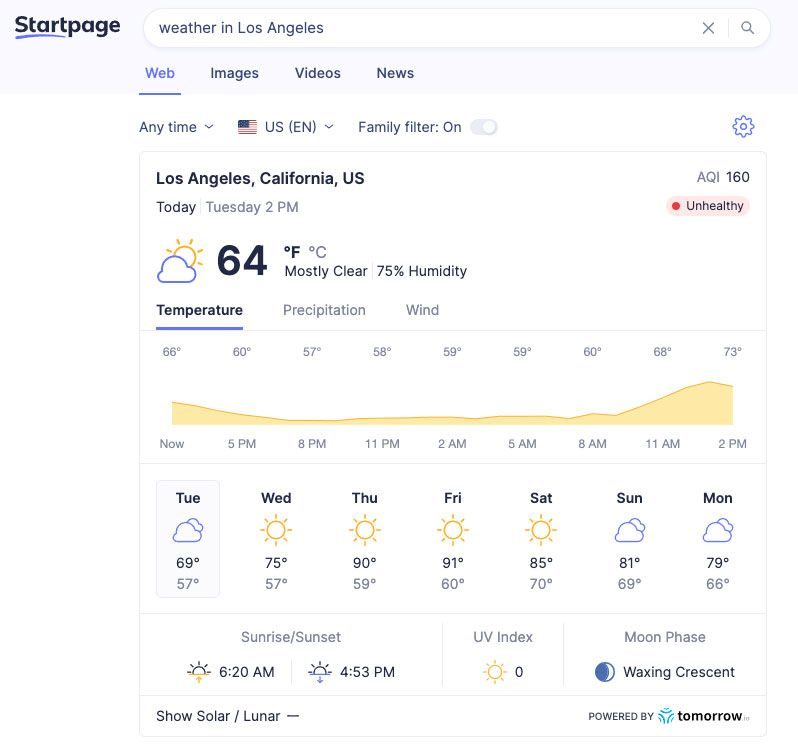
Startpage didn’t just stop at anonymous search results. They’ve quietly integrated hyperlocal weather data directly into the interface. This isn’t some basic lookup. It’s a partnership with Tomorrow.io designed to give you forecasts without handing your location data to a third-party tracker.
The data comes from Tomorrow.io’s widgets. These are robust. You get air quality metrics. Pollen counts. Fire risk levels. General summaries for multiple locations. Dan Slagen, Tomorrow.io’s chief marketing officer, framed this as a necessity. Weather and climate events dominate the daily news cycle now. People need actionable, hyperlocal forecasts. The implication is clear: you shouldn’t have to sacrifice privacy to stay safe or informed.
This stands in stark contrast to the legacy models of weather data collection. Most people don’t realize how much their current weather app is watching. It’s not just checking the temperature. It’s building a profile.
“With weather and climate-related events now in the daily news cycle, it’s more important than ever to provide the most hyperlocal and actionable forecasts to people everywhere throughout the world.”
You can try to fight back on your end. Disable tracking. Go into your phone’s settings. Find the app section. Locate your weather tool. Toggle off location services. Simple enough.
But don’t think you’re fully safe. Disabling location minimizes data collection. It doesn’t stop it. Depending on who owns your app, they already have other identifiers. IP addresses. Device fingerprints. Behavioral patterns. You’re still feeding them something. Just less precise something.
The history of this data exploitation is long. Look at IBM. They bought The Weather Company. In 2020, they launched IBM Watson Advertising. The goal was to use artificial intelligence to serve ads based on weather conditions. Their pitch was elegant. Weather drives emotion. Emotion drives action. So why not target people when the rain starts falling? They claimed they didn’t need third-party cookies or identifiers. They didn’t need them because they owned the weather data itself.
Startpage’s move sidesteps that trap. By pulling data from a provider focused on the forecast rather than the ad revenue, they remove the incentive to track you. The trade-off is manual entry for some users who disable location entirely. But that’s a conscious choice. It’s better than having your data sold to build an emotional profile for advertisers.
The question isn’t really about accuracy anymore. Tomorrow.io’s data is solid. Startpage’s integration is seamless. The question is whether you trust the middleman. Most weather apps are middlemen with profit motives. Startpage is just a conduit.
It’s a small shift in how we consume daily information. But it highlights a broader pattern in software. We accept data harvesting as the price of convenience. Until the alternatives are this easy to use.