




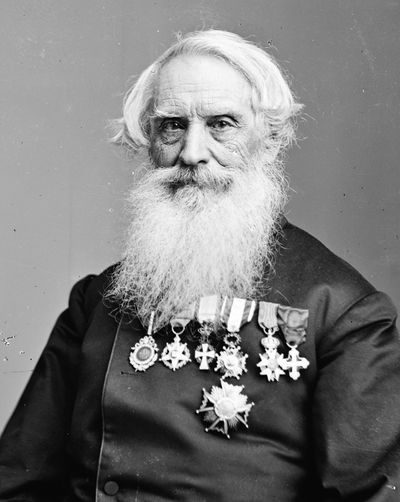
Samuel F.B. Morse didn’t start as a tech genius. He started as a painter with a questionable attention span.
Born in 1791 in Charlestown, Massachusetts, Morse was the son of Jedidiah Morse—a geographer and clergyman who probably dreamed his son would follow in his footsteps. Instead, Samuel drifted. He was an unsteady student at Phillips Academy. His parents, trying to steer him toward seriousness, sent him to Yale. There, he remained an indifferent scholar.
But electricity captivated him.
While his parents were distressed by his love for painting miniature portraits, Morse was busy listening to lectures on a subject barely understood at the time. Electricity. It was obscure then. It is everything now.
Graduating in 1810, Morse took a clerk job in Boston. It didn’t last. Painting remained his true calling. In 1811, his parents funded a trip to England so he could study with Washington Allston. The War of 1812 was raging. Morse, stung by English contempt for Americans, became fiercely pro-US. Yet he kept accepting English artistic standards. He loved the “historical” style. Grand poses. Brilliant colors. Romantic legends played out in the foreground.
When he returned to New York in 1815, the American public didn’t care for his historical canvases. They wanted portraits. So Morse adapted.
He became an itinerant painter across New England, New York, and South Carolina. Eventually, he settled in New York City. There, he painted some of the finest American portraits ever made. He blended technical skill with bold character sketches, keeping a touch of that English Romanticism.
Money was tight in those early years. But Morse was social. He moved in circles with intellectuals, the wealthy, and political conservatives. He had a gift for friendship.
Among his notable friends was the Marquis de Lafayette, a French hero of the American Revolution. Morse supported Lafayette’s liberal reforms in Europe. He also befriended novelist James Fenimore Cooper. They shared traits. Both were ardent republicans with aristocratic tastes. Both suffered from the American bias toward European art.
Morse also had leadership skills.
In 1827, he helped launch the New York Journal of Commerce. The paper refused theatre ads in a campaign against theatrical licentiousness. He was a founder of the National Academy of Design, established to boost respect for American painters. He served as its first president from 1826 to 1845.
This was the man who would soon change how humanity communicates. Before the code bears his name, he was just a struggling artist trying to make sense of a world that didn’t yet value his vision. He didn’t know it then, but his next chapter would redefine distance. The brush would be put aside. The wire would take over.
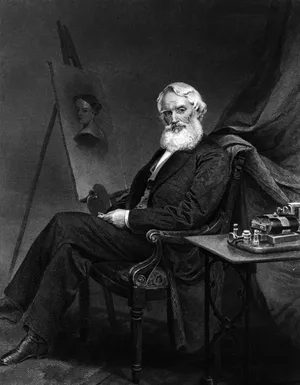
How Morse Code Changed Communication Forever
The origin story of the telegraph is less about engineering and more about boredom at sea. In 1832, Samuel Morse was on a ship returning from studying art in Europe. He overheard a conversation about electromagnets. That snippet of knowledge sparked an idea. It wasn’t the first time someone tried to send an electric signal. People had experimented since 1753. Short-range messages flew across wires by 1774. But Morse believed his concept was unique. He was wrong, but he didn’t know it. By 1835, he had built a working model. It was crude. It worked over a few feet.
Morse wasn’t a full-time inventor yet. He was a painter. He taught at the University of the City of New York. He ran for mayor of New York City on anti-immigrant and anti-Catholic tickets. He cared about politics and art. The telegraph was a side project. Then everything changed.
In 1837, he shifted focus. A chemist colleague named Leonard Gale introduced him to Joseph Henry’s research. Henry had built powerful electromagnets. This was the missing link. With Henry’s tech, Morse could push a signal 16 kilometers. His original model managed only 12 meters. The leap was massive.
Alfred Vail stepped in next. He had access to ironworks in Morristown, New Jersey. He provided materials and labor. He became a partner. Gale joined them too. The team needed a language for the clicks. By 1838, they had it. Dots and dashes. This became Morse Code. It was a simple system that solved a complex problem. It allowed human language to travel at the speed of electricity.
Getting funding was harder than building the machine. Morse tried to interest Congress. He failed. He tried in Europe. He failed again. He was alone in his persistence. His partners gave up. Morse kept pushing. Finally, in 1843, Congress agreed to fund the first line. It ran from Baltimore to Washington, D.C.
The line opened in 1844. On May 24, Morse sent the first message. “What hath God wrought.” It was a biblical reference. It was also a demonstration of power. Distance was no longer a barrier.
The Legal Battle for Telegraph Patents
Success attracts enemies. Morse’s partners turned on him. Rival inventors sued. He fought back. He was a controversial figure by nature. His father was similar. Morse argued about art with John Trumbull. He clashed with Unitarians and Catholics. He battled Irish immigrants and abolitionists. He even got into a dispute with François Gouraud over daguerreotypy. Morse was one of the first American practitioners of that photography style. He didn’t back down.
The telegraph lawsuits were the biggest. They dragged on for years. The conflict ended in 1854. The U.S. Supreme Court ruled in Morse’s favor. His patent rights were solidified. This decision defined the industry for decades. It allowed him to build wealth. His fame grew alongside the lines stretching across the Atlantic.
He bought Locust Grove in 1847. It was an estate near Poughkeepsie, New York. It overlooked the Hudson River. In the early 1850s, he built a mansion there. It was Italian villa style. He spent summers there. His large family joined him. Children. Grandchildren. He returned to New York City in winter. His brownstone home was his base.
Why Morse Matters in the Digital Age
Morse aged into a patriarch. He had a flowing beard. He became a philanthropist. He gave money to Vassar College. He was a founder and trustee there. He donated to Yale. He supported churches and seminaries. He funded Bible societies and temperance groups. He helped poor artists. He used his wealth to shape culture.
The world changed rapidly during his life. The telegraph shrank it. After he died in 1872, other inventions took the spotlight. The telephone. Radio. Television. The Internet. Morse’s fame faded. People forgot the man behind the dots and dashes. But his art remained. He never wanted to be known as a portrait painter. He wanted to be an inventor. Now, his paintings are celebrated. They are powerful. Sensitive.
He painted Lafayette. He painted William Cullen Bryant. He painted other prominent men. These works are exhibited across the United States. The number of telegraph operators has dropped to near zero. The technology is obsolete. Yet his memory survives. The Morse Telegraph Club was founded in 1942. It preserves the history of telegraphy. The Smithsonian holds his 1837 instrument. Locust Grove is a national historic landmark.
We live in a world built on instant communication. We take it for granted. We scroll. We click. We expect answers in seconds. Morse started that chain reaction. He turned a conversation on a ship into a global network. He didn’t just send messages. He changed how humans relate to distance. The code he created is still taught. Not because we use it to send war messages. But because it was the first step. The first link in the chain that leads to this screen.
The internet is just a faster telegraph. It’s all connected. And it all started with a dot.