

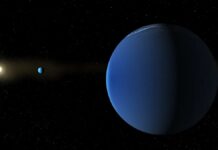

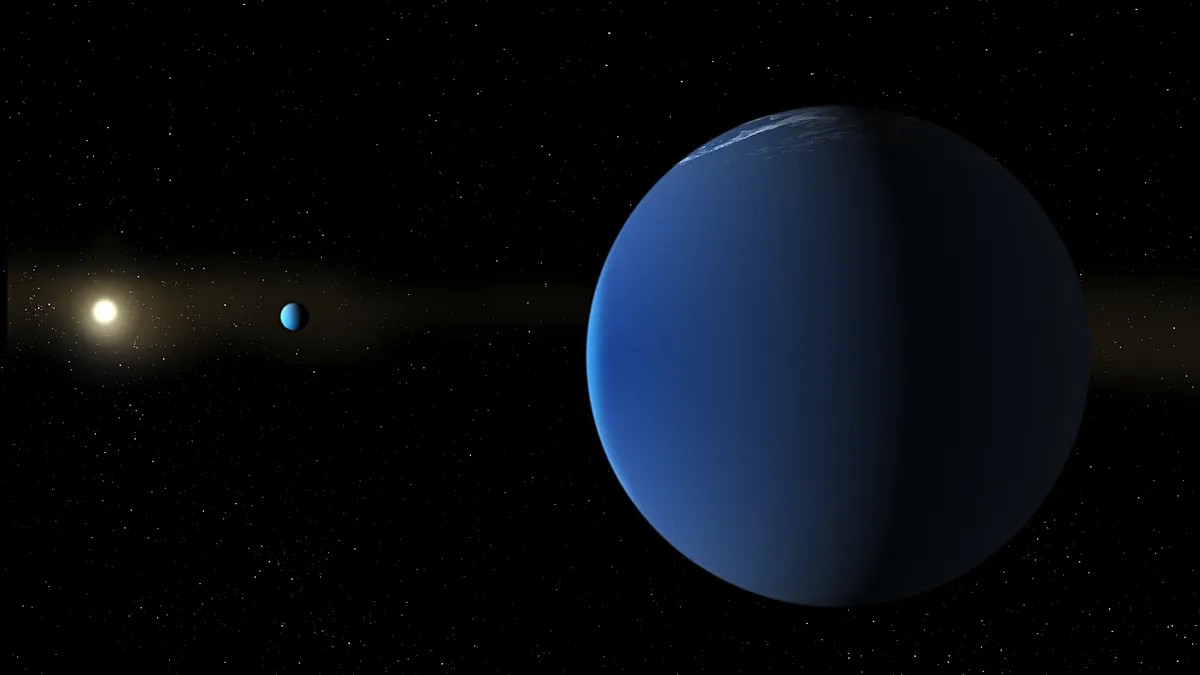
Bigger than Jupiter. Lighter than a breath. It sounds like a physics error, but the sky doesn’t care about our expectations. Astronomers have found two “super-puff” planets, giants that weigh almost nothing.
They orbit a distant star. More than 1,100 light-years away, in the southern sky constellation Volans—the flying fish. If you’ve never seen a flying fish star pattern, imagine it as a quiet corner of the dark. These planets are the featherweight champions of space.
George Dransfield led the team from the University of Oxford. She says they aren’t dense at all. Think of shaving foam. Not cotton candy, which pulls and stretches, but a blob. A solid, airy blob just out of the can. That is their density.
NASA’s TESS satellite spotted them. Before this, no exoplanet of this size had such low mass. They are the lightest big planets we have ever confirmed. Jupiter? Forget it. The gas giant is up to 35 times denser. It would crush you; these puffs would likely just… be there. Floating.
“These two planets have densities comparable to anice blob of shaving foam,” Dransfield said.
So what are they? Probably hydrogen. Probably helium. Standard gas ingredients. Dransfield thinks they might be white or blue, depending on how their clouds hang. Pink? No. They aren’t sugary confections.
Rare beasts. True super-puffs number fewer than 40. NASA has cataloged nearly 6,30 exoplanets total. These are the weird ones. The statistical outliers. They form in thick gas discs around young stars, then shed their mass. Like a balloon leaking air for billions of years, they stay huge but get light.
Why look at them? Why stare into the deep freeze of 9.7-trillion-kilometer distances?
We are solving the puzzle of how planets build themselves. These ghosts tell us something about the rules. About what stays, what goes.
We will wait for NASA’s Webb Space Telescope. It will sniff their atmospheres, confirm the chemicals. Until then, we just know they are there. Big, light, and strange.