



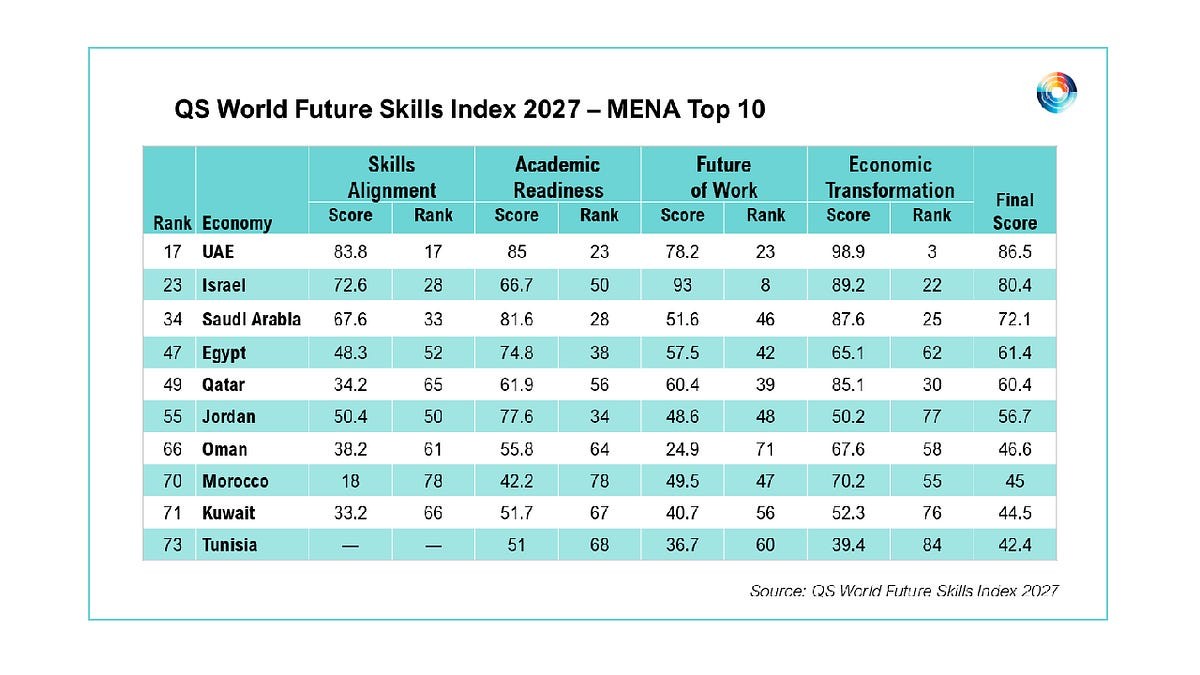
The UAE sits at 17th place out of 89 economies. It’s the best spot in the Middle East and North Africa for the QS World Future Skills Index 27. The score is 86.5. That number matters because it shows where the region stands on preparing workers for tomorrow’s economy.
The UAE topped the MENA region in both Skills Alignment and Academic Readiness, outpacing the regional median by wide margins.
This isn’t just about academic stats. The UAE leads in Skills Alignment with an 83.8 score. Compare that to the MENA median of 40.3, and the gap is obvious. Academic Readiness is also a regional leader at 85.0.
But the real story lies elsewhere. The country ranks third globally in Economic Transformation. That score is 98.9. Only China and Taiwan score higher. Being the only MENA entry in the global top ten for this indicator is significant.
Why the UAE’s Economic Score Matters
The gap between the Economic Transformation score and the Skills Alignment score tells you something important about the local labor market. Growth is happening faster than the local supply of job-ready graduates.
This mismatch exists globally. It is especially sharp in places making huge jumps with artificial intelligence. The UAE has answered this by pulling in global talent. It is a magnet for AI experts from abroad. That mix of foreign and home-grown expertise powers the fast-growing ecosystem.
How Other MENA Countries Compare
Saudi Arabia followed as the region’s next highest scorer. It ranks 34th globally. The score is 72.1.
The report calls Saudi Arabia an “Over-Converting Economy.” This means the country turns a weaker academic base into stronger economic results. It does this through industrial policy. It integrates foreign talent. It focuses on technology transfer.
The kingdom is moving past oil and gas. Universities there are using their research strengths. They are building advantages in:
– Renewables
– Mining
– Space technology
– Nuclear energy
Israel ranks 23rd with a score of 80.4. That places it second in the region. The top five Arab economies, in order, are the UAE, Israel, Saudi Arabia, Egypt, and Jordan.
What Drives These Rankings
The index looks at how well education systems meet future economic needs. It weighs skills alignment closely. This measures how closely academic outputs match what industries need.
Academic Readiness is another key metric. It assesses the preparedness of students for higher-level work. The UAE’s score here is close to India’s. India led South Asia with an 86.7 score.
Specialization seems to beat scale. Smaller economies like Singapore and the Netherlands rank high. They prove you don’t need a huge population to lead in specific areas.
The Global Landscape of Future Skills
The United States tops the list globally. The score is 99.2. Australia sits at 97.5. The United Kingdom comes in at 96.5. Germany rounds out the top four at 95.5. Canada is fifth at 93.7.
But the global picture is fragmented. AI is widening gaps. It isn’t disrupting everyone evenly. Five key patterns emerge from the data on 89 national economies.
First, skills gaps persist even as some countries close them. Targeted policy helps here. Second, the mix of jobs matters. Economies that use AI to augment human work rather than automate it away will likely stay competitive longer.
Third, universities alone don’t drive growth. Coordination between higher education, industry, and government is required. Without it, strong academic institutions sit idle.
Fourth, higher education is moving too slowly. Workplace transformation outpaces curriculum changes. Employers are frustrated.
Finally, specialization wins. You don’t need to be the biggest to be the best prepared. You just need to align with what the future economy demands.
The UAE is leading because it recognizes this need. It fills its pipeline with global talent while pushing local education. The result is a strong position in the metrics that define economic resilience. Whether it can maintain that lead as other regions catch up is another question.